

Suna Besha 2026 – Witness the Divine Golden Form of Mahaprabhu Shri Jagannath
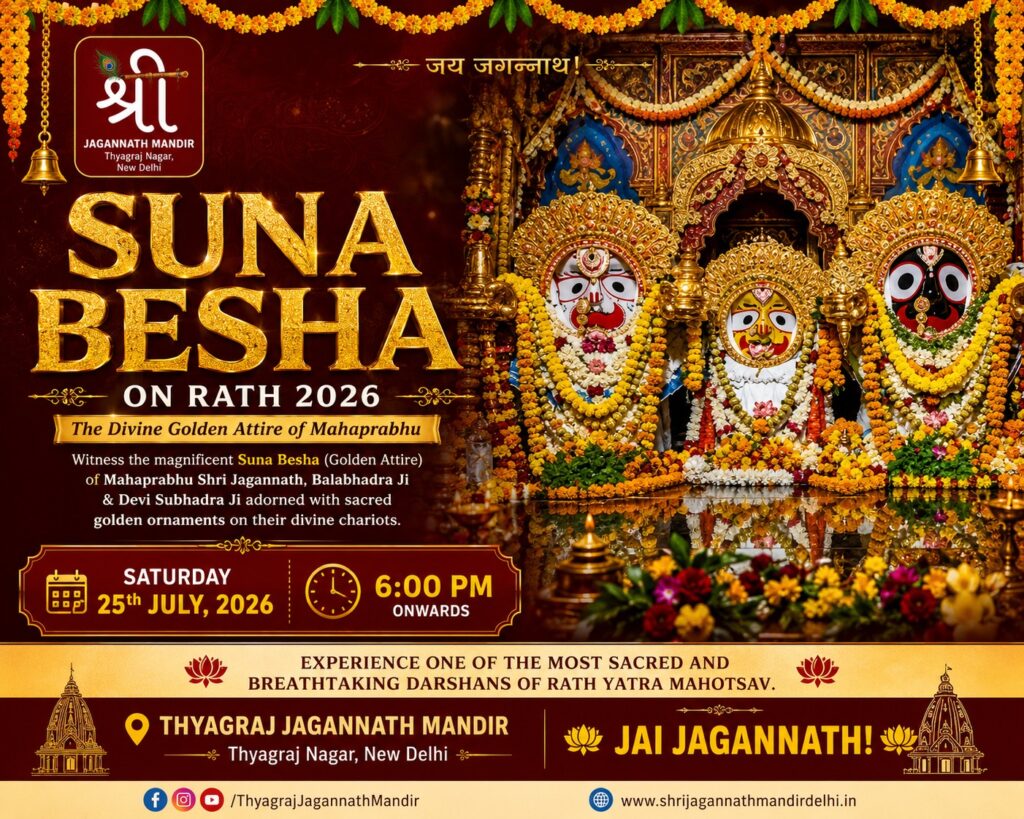
Among all the rituals celebrated during the Rath Yatra Mahotsav, Suna Besha is one of the most magnificent and spiritually uplifting. The word “Suna” means gold, and “Besha” means attire or adornment. During this sacred ritual, Mahaprabhu Shri Jagannath, Mahaprabhu Balabhadra, and Devi Subhadra are beautifully decorated with exquisite golden ornaments while seated on Their divine chariots.
The sight of Mahaprabhu adorned in radiant gold is breathtaking and fills every devotee’s heart with devotion and joy. Thousands gather to witness this rare darshan, believing that seeing Mahaprabhu in His golden form brings divine blessings, prosperity, and spiritual upliftment.
This year, devotees in Delhi are invited to experience the divine Suna Besha 2026 at Thyagraj Jagannath Mandir, New Delhi, where this sacred tradition will be celebrated with great devotion and grandeur.
What is Suna Besha?
Suna Besha, also known as Raja Besha (Royal Attire), is the ceremonial adornment of Mahaprabhu Shri Jagannath, Mahaprabhu Balabhadra, and Devi Subhadra with sacred gold ornaments after the completion of Bahuda Yatra.
Unlike the daily attire of the deities, this special adornment transforms Mahaprabhu into His majestic royal form, symbolizing His supreme position as the Lord of the Universe.
The dazzling golden ornaments reflect not worldly wealth, but the limitless spiritual glory and compassion of Mahaprabhu.
The History of Suna Besha
The tradition of Suna Besha has been observed for centuries in the Jagannath tradition. Historical records associate the formal practice with the Gajapati Kings of Odisha, who offered gold ornaments to Mahaprabhu as an expression of gratitude and devotion.
The ornaments are considered sacred offerings and are preserved with utmost care. Every year, they are brought out only on this auspicious occasion to adorn Mahaprabhu.
Over time, Suna Besha became one of the most anticipated events of Rath Yatra, drawing devotees from across India and around the world.
Why is Suna Besha Celebrated?
Suna Besha reminds devotees that Mahaprabhu is the Supreme Protector, King of the Universe, and the source of all prosperity.
The golden ornaments represent:
- Divine sovereignty.
- Victory of righteousness over evil.
- Abundance through devotion.
- Compassion toward all living beings.
- The eternal glory of Mahaprabhu.
Rather than symbolizing material wealth, the gold signifies the priceless treasure of faith, humility, and devotion.
The Sacred Ornaments of Mahaprabhu
During Suna Besha, Mahaprabhu is adorned with specially crafted golden ornaments, each carrying symbolic significance.
These include:
- Golden Crown (Mukut) – representing divine sovereignty.
- Golden Hands (Hasta) – symbolizing protection and blessings.
- Golden Feet (Pada) – reminding devotees to surrender at His lotus feet.
- Golden Weapons and Emblems – representing the victory of dharma.
- Golden Necklaces and Ornaments – reflecting His infinite beauty and divine majesty.
Every ornament is placed with great care while Vedic hymns and devotional kirtans fill the atmosphere.
Spiritual Significance of Suna Besha
Suna Besha teaches us that true wealth is not measured by gold or material possessions but by devotion to Mahaprabhu.
The golden form reminds devotees to cultivate:
- Faith in difficult times.
- Humility despite success.
- Gratitude for divine blessings.
- Compassion toward all beings.
- Dedication to righteous living.
Seeing Mahaprabhu in this majestic form inspires devotees to look beyond worldly desires and seek lasting spiritual fulfillment.
Rituals Performed During Suna Besha
The ceremony begins after the completion of Bahuda Yatra, when the three divine siblings remain seated on Their chariots.
The ritual includes:
Sacred Preparations
Temple priests prepare the ornaments with traditional rituals and prayers.
Alankara Seva
Mahaprabhu Shri Jagannath, Mahaprabhu Balabhadra, and Devi Subhadra are ceremonially adorned with the sacred golden ornaments.
Vedic Chanting
Priests recite sacred mantras while devotees sing bhajans and kirtans.
Maha Darshan
Thousands of devotees gather to witness this rare and divine sight.
Evening Worship
The day concludes with special arati, bhoga offerings, and devotional celebrations.
Why Every Devotee Should Witness Suna Besha
For devotees, Suna Besha is more than a festival—it is an opportunity to experience Mahaprabhu in His most majestic form.
Witnessing this sacred darshan:
- Strengthens devotion.
- Inspires inner peace.
- Fills the heart with gratitude.
- Connects devotees with centuries-old Jagannath traditions.
- Creates lifelong spiritual memories for families.
Suna Besha 2026 at Thyagraj Jagannath Mandir, New Delhi
Experience one of the most awaited rituals of Rath Yatra Mahotsav 2026 at Thyagraj Jagannath Mandir.
Event Details
📅 Date: Saturday, 25 July 2026
🕕 Time: 6:00 PM Onwards
📍 Venue: Thyagraj Jagannath Mandir, Thyagraj Nagar, New Delhi
Come and witness Mahaprabhu Shri Jagannath, Mahaprabhu Balabhadra, and Devi Subhadra adorned in Their magnificent golden attire.
Join thousands of devotees for this divine celebration and receive the blessings of Mahaprabhu.
A Divine Invitation
With immense joy, Thyagraj Jagannath Mandir, New Delhi, invites you and your family to participate in Suna Besha 2026.
Experience:
- The magnificent Golden Darshan of Mahaprabhu.
- Traditional Jagannath rituals.
- Soulful bhajans and kirtans.
- A spiritually uplifting atmosphere.
- The opportunity to seek Mahaprabhu’s blessings during one of the most sacred moments of Rath Yatra Mahotsav.
Come and be a part of this unforgettable spiritual celebration.
JAI JAGANNATH!
About Thyagraj Jagannath Mandir, New Delhi
Established in 1968, Thyagraj Jagannath Mandir is one of the oldest Jagannath temples in Delhi NCR and has been preserving the rich traditions of Jagannath culture for over five decades.
The temple hosts daily worship, seva, festivals, spiritual discourses, cultural programs, and one of Delhi’s most celebrated Rath Yatra Mahotsav celebrations.
How to Reach
Thyagraj Jagannath Mandir
Thyagraj Nagar, Near Thyagraj Sports Complex, New Delhi – 110003
Frequently Asked Questions (FAQs)
Suna Besha is the sacred golden adornment of Mahaprabhu Shri Jagannath, Mahaprabhu Balabhadra, and Devi Subhadra during Rath Yatra Mahotsav.
“Suna” means gold, and “Besha” means attire. The deities are adorned with sacred gold ornaments.
Saturday, 25 July 2026, from 6:00 PM onwards.
No. Entry is free for all devotees.
Yes. Families, children, and devotees of all ages are welcome.
Photography is generally permitted unless restricted in certain ritual areas. Devotees should follow temple guidelines.
The next major ritual is Adhara Pana, where a sacred sweet offering is presented to Mahaprabhu on the chariots.